Trump's Tariffs at One Year: What They're Really Costing You
Trump's tariffs hit their one-year anniversary. Studies show American consumers pay 96% of the cost — not foreign exporters. Here's how much they're adding to your bills and what the Supreme Court might do about it.

John Mitchell
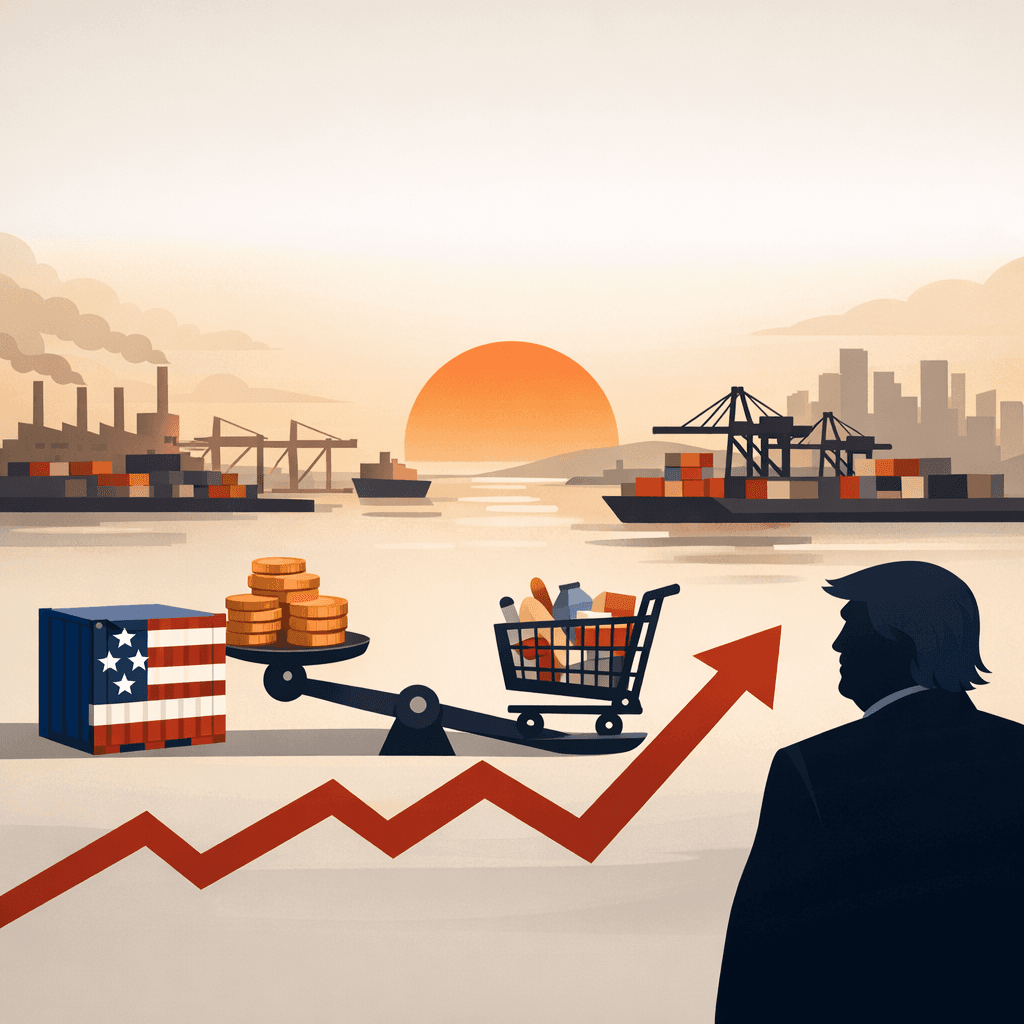
The Trump administration just hit its one-year anniversary of the most aggressive tariff policy since the Great Depression. And if you've noticed your grocery bill creeping up, your appliances costing more, or electronics getting pricier — you're not imagining it.
Here's the uncomfortable truth the administration doesn't want you to hear: You're paying almost all of it.
The Numbers Don't Lie
When President Trump announced his sweeping tariff policy in early 2025, he repeatedly claimed foreign exporters would foot the bill. "They pay tariffs to us," he said at the time. The premise was simple: slap fees on imports, and foreign companies absorb the cost for the privilege of selling to Americans.
Multiple studies have now demolished that claim.
The Kiel Institute analyzed $4 trillion in shipments between January 2024 and November 2025. Their finding? Foreign exporters absorb only about 4% of the tariff burden. The other 96% gets passed along to U.S. importers — who then pass it to you.
Goldman Sachs economists found similar results: U.S. companies and consumers collectively paid 84% of tariffs as of October 2025. They estimate consumers alone will bear 67% of the burden by July 2026.
Even the Harvard Business School study that Trump himself cited to claim victory reached the opposite conclusion. According to the actual report: "Our results suggest that U.S. consumers paid up to 43% of the tariff burden, with the rest absorbed by U.S. firms."
In other words: American consumers and businesses are paying — not China, not Mexico, not Europe.
How Much Are You Actually Paying?
The average effective U.S. tariff rate jumped from 2.5% to approximately 17% as of November 2025 — the highest level since the 1930s Smoot-Hawley Tariff Act that worsened the Great Depression.
According to Harvard Business School research cited by Reason:
- Prices for imported goods are up 9.7% from their pre-tariff trends
- Domestic prices are up 4.4% as companies face higher input costs
Here's where it hits your wallet:
At the Store
Electronics, appliances, clothing, and furniture have all seen price increases tied directly to tariffs. Anything made with steel, aluminum, or copper costs more — and that affects everything from cars to cookware.
At the Pump (Sort Of)
While oil isn't directly tariffed, the economic uncertainty has kept energy markets volatile. And steel tariffs affect pipeline construction costs, which trickle down to utility bills.
At the Car Dealership
The 25% tariff on imported cars from most countries means if you're buying a Toyota, Honda, BMW, or any foreign-made vehicle, you're paying a significant premium. Even "American" cars often use imported parts, so domestic vehicles aren't immune.
Food Prices
Agricultural products face retaliatory tariffs from trading partners, hurting American farmers. But imported ingredients and food products cost more too — a double whammy.
What About Those Tariff Revenues?
The administration points to record tariff revenue — $287 billion in 2025, a 192% increase from 2024 — as proof the policy is working.
But here's the catch: that money comes from U.S. importers (ultimately you), not foreign governments. It's essentially a consumption tax with extra steps.
The Tax Foundation has called the administration's suggestion that tariff revenues could replace income taxes "mathematically impossible." Even at current record levels, tariff revenue would cover less than 25% of the cost of eliminating income taxes for those making under $200,000.
The Supreme Court Factor
Here's where it gets interesting: A major Supreme Court decision on tariff authority is imminent.
The case, Learning Resources v. Trump, challenges whether the President can impose sweeping tariffs under the International Emergency Economic Powers Act (IEEPA) without explicit Congressional approval.
The administration has invoked "national emergencies" related to border security, energy, and trade deficits to justify tariffs without going through normal trade processes. Seven federal lawsuits argue this is executive overreach.
If the Supreme Court rules against the administration, some or all of these tariffs could be rolled back — potentially triggering refunds for importers who've already paid billions in duties.
The Customs bond market has exploded as a result, with billions of dollars riding on the outcome.
What About Manufacturing Jobs?
The stated goal of tariffs was to bring manufacturing jobs back to America. One year in, the evidence is mixed at best.
According to Wikipedia's summary of economic studies:
- Job growth slowed significantly in 2025
- "The promised growth in manufacturing jobs has not been realized"
- Corporate bankruptcies hit their highest level since 2010
Some companies have announced domestic investments, but economists point out these announcements often don't materialize — and when they do, automation typically creates far fewer jobs than old-school manufacturing.
Meanwhile, retaliatory tariffs from trading partners have hurt American exporters, particularly in agriculture.
The Stock Market Warning
Amid all this, the stock market is flashing warning signs.
The S&P 500's cyclically adjusted price-to-earnings (CAPE) ratio averaged 39.9 in January 2026 — the fourth consecutive month above 39. The last time the CAPE stayed above 39 for multiple months? October 2000, during the dot-com crash.
Historically, when the CAPE exceeds 39:
- Average 6-month return: 0%
- Average 1-year return: -4%
- Average 2-year return: -20%
The Motley Fool notes that tariffs "threaten to slow economic growth" because consumer spending and business investment — both hurt by tariffs — account for about 85% of GDP.
What You Can Do About It
You can't single-handedly change trade policy. But you can adapt:
1. Buy strategically. Major purchases like appliances, electronics, or vehicles? Research which brands manufacture domestically or in countries with lower tariff rates.
2. Consider timing. The Supreme Court ruling could change everything. If you can wait on big purchases, you might benefit from price drops if tariffs are rolled back.
3. Focus on what you control. Tariff-driven inflation eats purchasing power. Combat it by maintaining an emergency fund, maxing out high-yield savings accounts (still paying around 5% APY), and avoiding high-interest debt.
4. Watch the news. The Supreme Court decision could drop any day. If tariffs get struck down, prices could shift quickly.
The Bottom Line
One year into Trump's tariff experiment, the verdict is clear: American consumers and businesses are bearing the overwhelming majority of the cost. Import prices are up nearly 10%, domestic prices are up over 4%, and the manufacturing job boom hasn't materialized.
The Supreme Court may soon weigh in on whether this policy even survives. Either way, your wallet has already felt the impact.
Sources: Tax Foundation, Wikipedia - Tariffs in the Second Trump Administration, Motley Fool, CNBC, Reason. Data as of February 2026.
Continue Reading
More from Budgeting
 Budgeting
December Retail Sales Came in Flat — Here's What That Means for the Economy
The Census Bureau's delayed December retail sales report missed expectations, raising questions about consumer strength heading into 2026. Here's what it means for your wallet and the broader economy.
 John Mitchell
 Budgeting
When Will You Get Your 2026 Tax Refund? IRS Delays Could Slow Things Down
Tax season is here, but IRS staffing cuts and the government shutdown could delay your refund. Here's when to realistically expect your money and how to check your status.
John Mitchell Budgeting
Consumer Confidence Is Rising — But Americans Still Feel Broke. Here's Why.
The University of Michigan Consumer Sentiment Index hit its highest level since August 2025. But dig into the data and Americans are still worried about high prices and job security. Here's the disconnect.
John Mitchell Budgeting
Jobless Claims Jump to 231,000 — Should You Be Worried?
Weekly unemployment claims jumped 22,000 to 231,000 — the biggest increase in two months. But economists say the labor market is still stable. Here's what's really happening.
John MitchellYou May Also Find Interesting
 Investing
China Tells Banks to Cut US Treasury Holdings: What It Means for American Investors
Chinese regulators are urging banks to reduce their US Treasury exposure. Here's what this trend means for interest rates, the dollar, and your portfolio.
John Mitchell Investing
How to Start Investing With $100 (A Beginner's Guide for 2026)
You don't need thousands to start investing. With just $100 and a smartphone, you can begin building wealth today. Here's exactly how to do it step by step.
John Mitchell Retirement
401(k) Basics: Everything You Need to Know in 2026
Your employer offers a 401(k). Should you use it? How much should you contribute? What's a match? Here's the complete beginner's guide to the retirement account that could make you a millionaire.
John Mitchell Investing
Dow Hits 50,000 for the First Time — What It Means for Your Portfolio
The Dow Jones Industrial Average closed above 50,000 for the first time in history on Friday. Here's what drove the rally and what this milestone actually means for everyday investors.
John Mitchell